



Nothing New in the Endless Yellow Rooms
A Halloween theology essay on The Backrooms. The Backrooms remembers everything and loves nothing. Salvation from despair requires a different kind of Being.
We're happy to provide a free audio version of this essay for all our readers who prefer listening!
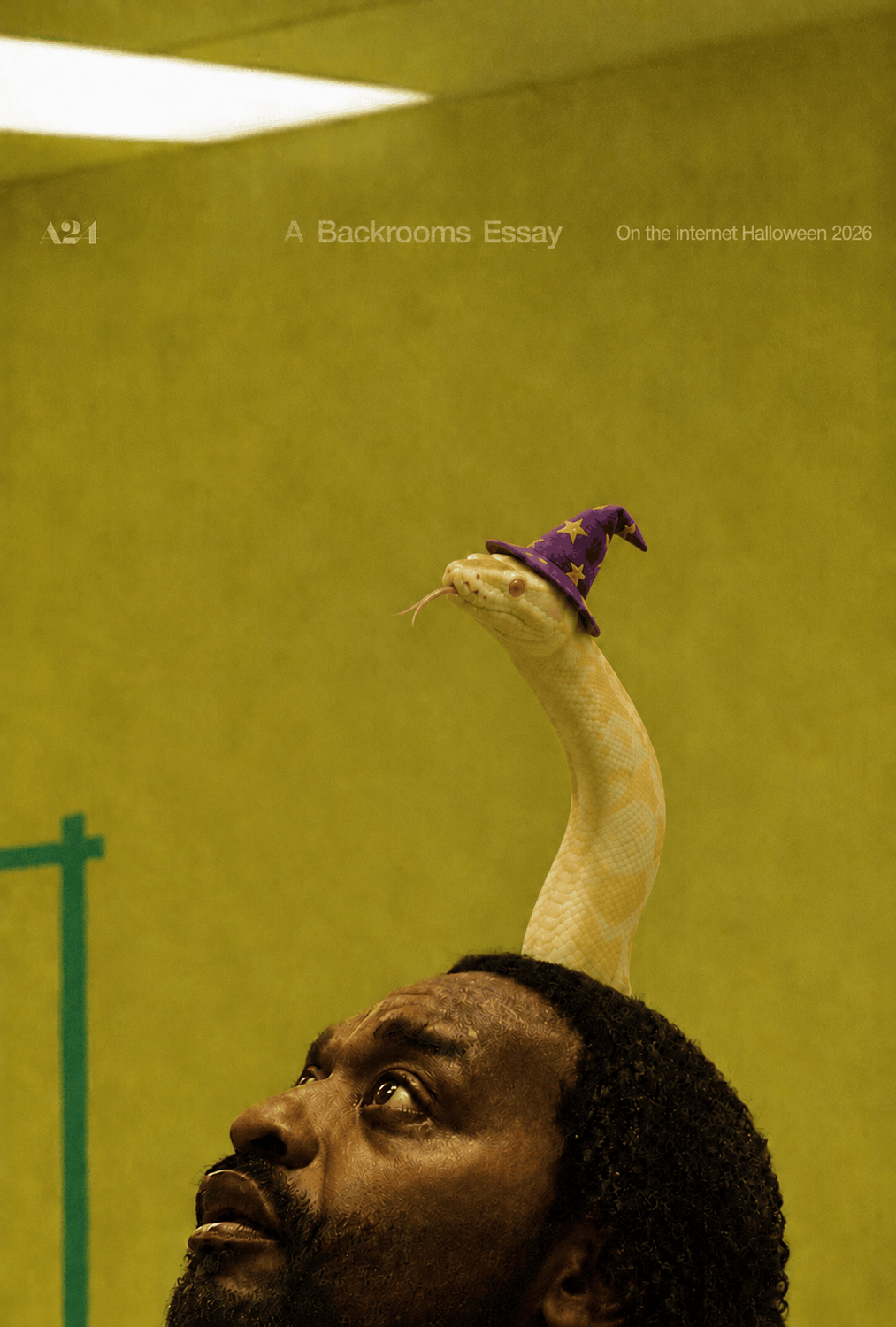
“The more it remembers something, the less it does.”
~ Clark, Backrooms (A24, 2026)
A Fear With a Floor
I am an Orthodox Christian with a nihilist heart. I have depression—the kind that affects your personality as a whole, rather than coming in episodes. I’ve had it for as long as I can remember.
Whenever a good thing happens, or I encounter something beautiful, the same conclusion always lingers in my mind: “This, and everything like it, is worthless. It will all disappear.” It’s a feeling and a thought, so it’s resistant to the pop-psychology advice to either “live in the moment,” or “realize your feelings aren’t you.” Whether it’s over friendships, performances, parties, relationships, I usually feel like I’m waiting for the “dismal tide” to roll in.
Here’s an example of how that plays out in everyday life. I love Cinnamoroll, Sanrio’s little white angel puppy. Whenever I see a really lovely piece of art of him (and there are many on my Instagram feed), the sadness arrives right on time: “even this will disappear. So does it even matter?”
The cuter the drawing, the louder the thought. Sweetness makes the dread worse sometimes.


Both drawings by @hanamintsukimin, also known as Mattake (まったけ). Whatever saves us has to save this, or it won’t be enough.
Mentally, it’s hard for me to stay in the present. My mind is usually floating around either ancient times, or the heat death of the universe when even the atoms are too exhausted to bond. And when the mind goes to such places, the conclusion is natural:
“Effort must be worthless… the good here will be forgotten, and being forgotten is worse than having never existed at all.” I feel it, and I think it.
Trying to express that horror to others has always been difficult. If they hadn’t read Nietzsche or Cormac McCarthy, there wasn’t much I could talk about to get the problem across.
But then the modern myth of The Backrooms came about, through internet meme forums. People started reflecting on the horrors of time, memory, infinity, and decay, all through The Backrooms. And I think Kane Parsons’ canon about The Backrooms captures the horror better than any other version.
A confession before we go in: I know there’s an answer to the existential horror we’re about to enter, although I rarely feel that it’s real. I’m writing from inside the existential maze. Whatever I write here is offered to whoever else is in the endless yellowed halls too.
Blueprints of The Backrooms
If you’ve never encountered stories about The Backrooms, let me summarize. If you have, you’re welcome to skip down to the later section, “More Rooms Than Numbers.”
The Backrooms began as an internet legend, a creepy thought experiment. It’s an endless maze of rooms with bizarre architecture, based on this single (real-life) photo of a rotting office space.

This photo alone is enough to creep some people out. It’s the perfect “liminal space”—a place that you’re supposed to get out of rather than inhabit. It feels vaguely hostile to your presence.
For years, the original location of the photo was unknown, and the original author is still anonymous. These two unknowns let imaginations run wild, and the unknown is the most fertile ground for fear. Anyone could take this short prompt and spin it into a scary story.
Imagine, for example, that the space in the photo extends forever as an endless maze of yellow walls, humming fluorescent lights, and old carpet. Imagine this as its own alternate dimension: with no escape, and no people. If you randomly fall into this space, it’s nothing but you and the echoes of infinity.
Some versions of The Backrooms myth add levels and monsters and the possibility of escape to their stories, but infinity creates dread without adding monsters written by teenagers trying to power-scale “the scariest entities ever.” It’s infinity that I’m concerned with.
What I want to draw attention to is Kane Parsons’ stories of The Backrooms. He has already spent years forging its premise into a bona fide myth, with its own literary canon and themes.
Parsons’ Backrooms series is almost entirely free to watch on YouTube, under his channel “Kane Pixels.” The one exception is the film, released to theaters in May 2026, directed by Parsons and distributed by A24. The movie keeps strict continuity with the videos.
The Kane Parsons Lore
Parsons’ Backrooms story is told through found-footage—old VHS tapes from the 1990s that were apparently lost and recovered. Parsons’ story is an alternate history to our own world, with history diverging around 1989.
In California, the Async Research Institute is experimenting with magnetic fields, as part of their production of MRI machines. Somehow, the magnetic fields within their labs interact with cosmic magnetic fields, and create portals to another dimension: The Backrooms.
But once that first portal is open, unstable portals start randomly opening and closing across the world. Ordinary people keep falling into portals they can’t even see, and they become trapped within. To the outside world, they disappear without a trace.
One day, an invisible portal may appear on your bedroom floor. And by the time you reorient yourself from the fall, you’re stuck within the endless yellow with no clear path.
Those who enter The Backrooms find an infinite maze of bizarre architecture. What’s really strange is that many spots within The Backrooms seem… familiar.
The rooms themselves seem to be remembering and recreating certain moments from our real world. Within The Backrooms, people find simulacra of their childhood homes, their own clothing, replicas of furniture they own.
Whatever The Backrooms is, it seems to be conscious. It observes, remembers, and replicates, and will repeat that process endlessly.
The place itself is a horror. It was built for no one, for no purpose, yet it continues forever. Once you are lost within, you will be forgotten. It’s virtually a guarantee your body won’t be found.
As we watch Parsons develop The Backrooms’ story, we are witnessing a new myth being written in real time. A myth is what a culture creates when it has a fear it can’t quite name. The foundation of The Backrooms is a primordial human fear: “I will live and die unwitnessed, unremembered, as if I never existed at all. All my efforts are worthless.”
The Backrooms myth doesn’t need monsters, because the fear it names is a philosophy, a grim realization, what internet horror calls a cognitohazard, what literary horror calls forbidden knowledge: everything decays. Meaningless, meaningless; everything is meaningless!
Every aspect of Kane Parsons’ story reflects decay; the series is found footage on decaying VHS tapes, recorded by people who have disappeared from history. The Backrooms in its “normal” state resembles generic office spaces from the 90s and 00s; the kind our grandparents and parents spent their entire careers within. It’s architecture that everybody half-remembers, but was never meaningful enough for anybody to truly memorize.
In other words, The Backrooms manifests memories that are decaying within us—nostalgia without anything worth reminiscing over.
Decay presents itself in almost every aspect of Kane Parsons’ Backrooms story:
The architecture is decaying
The media that tells the story is decaying
The people who witnessed the place are now decaying
The Backrooms rebuilds memories that were decaying in people’s minds
The Backrooms forces you, the viewer, to face the fact that you will decay too
More Rooms Than Numbers
Again, there is no single authority about the lore of The Backrooms, but most authors treat it as infinite.
The Backrooms seems to contain every possible combination of physical things in our universe. In the Parsons storyline, characters find their childhood homes, their own offices, moments from their memories, all randomly strewn across The Backrooms in various conditions. On top of replicas, they also find distorted echoes of the same things: furniture clips into the floor, iterations of their homes grow random holes and nonsensical spaces.
There are even distorted people (called Still Lifes), wandering the spaces like zombies, as if the entity remembering those people doesn’t understand anatomy, biology, or the point of making life at all.
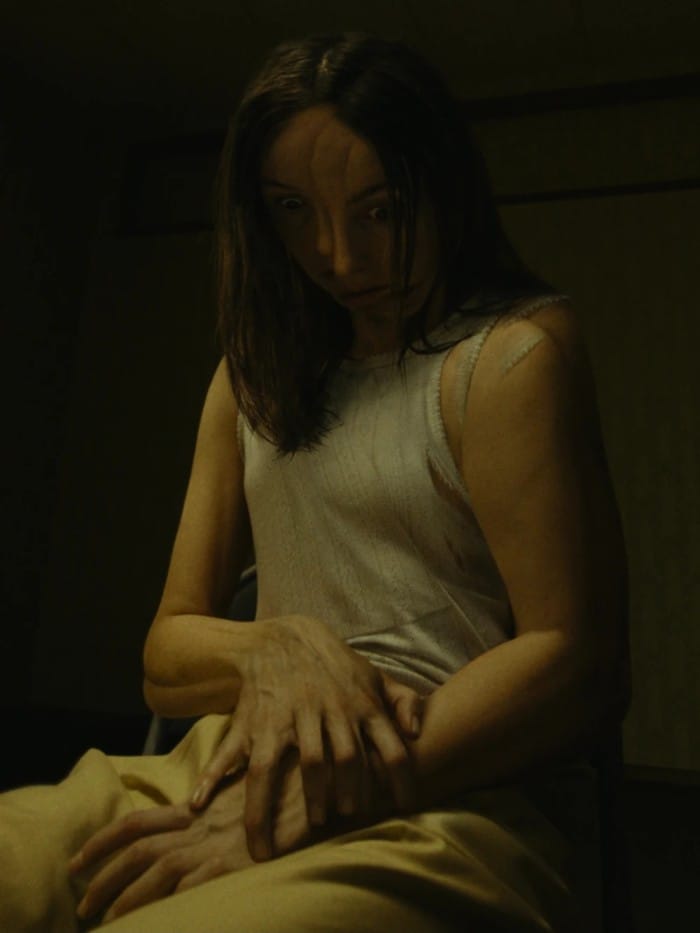
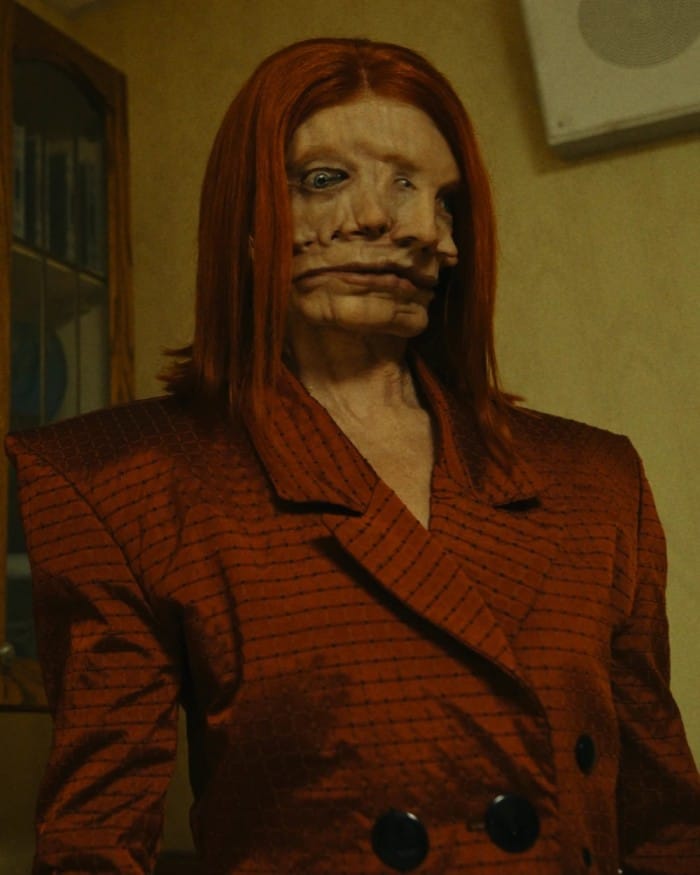
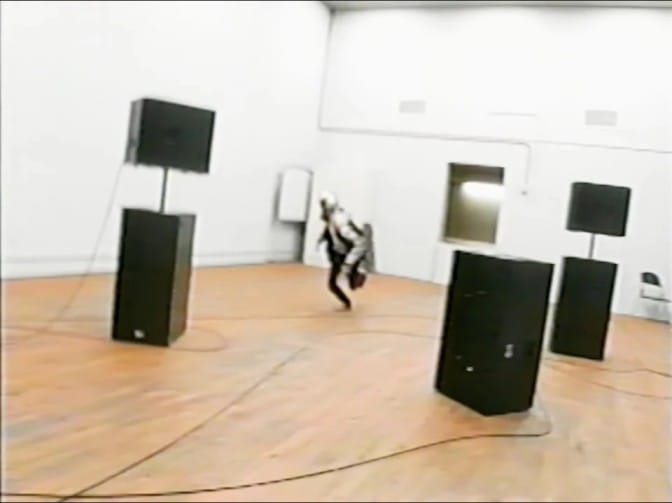
Still Lifes from Kane Parsons' storyline. Sweet Potato does not like them; he hissed at all of them.
The Backrooms is related to Jorge Luis Borges’s The Library of Babel (1941): a universe that is simply a huge library, every shelf full of books holding every possible combination of letters. Nearly all of it is gibberish. Somewhere within, though, is every book ever written and to-be-written, including the one that tells your life story.
The Library is enormous, but finite: Borges himself knew the number of books, “though extremely vast, is not infinite.” We now know that the number of books is a number that has about 1.8 million digits. (The website libraryofbabel.info reports a much smaller figure, about 10⁴⁶⁷⁷, because it can only handle about a page, not entire books.) A patient mathematician (or stubborn YouTuber) could write out 1.8 million digits.
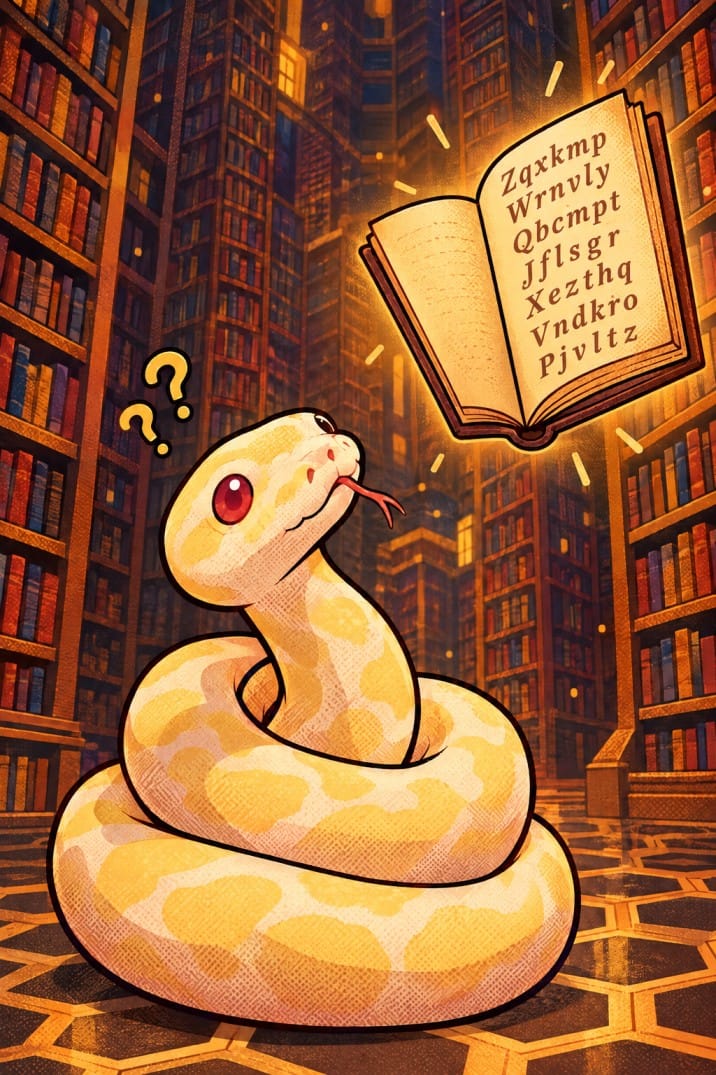
I sent Sweet Potato to the Library of Babel for research. His mission is to find a book that truly conveys the depth of our friendship. He’s still looking.
The Backrooms has no such limit, because it has no alphabet. Its “letters” are rooms, furniture, bodies, and the distances between them. Take the furniture store in Parsons’ film, Cap’n Clark’s Ottoman Empire. The main character finds herself in one copy of it, with the showpiece furniture slightly rearranged. In another copy, a chair has moved a hand’s length; in another, two; in another, it is halfway sunk into the floor.
Parsons gives us enough data to establish a size range, although the lower range is still uncountable.
At the smallest bound of its size, The Backrooms holds only physically possible arrangements of matter. Even with those limits, The Backrooms will be uncountably large. Slice a shoebox-sized region into millimeter cubes, call each one solid or empty, and the possible arrangements within a shoebox already outnumber the books in the whole Library of Babel. Imagine the arrangements available within the space of a house, or a store.
At the upper bound of its size, The Backrooms can’t be counted with a number. Move the chair any distance and its positions fill a continuum, which Georg Cantor proved in 1891 cannot be put in any list. Let the place copy whole houses, whole people, and copies of copies, and Cantor’s theorem says you can always create a larger collection. There is no largest infinity and no final tally.
Whatever The Backrooms holds, there is always more it could hold. It might even begin holding replicas of itself, which is why storytellers usually conclude that it’s still growing.
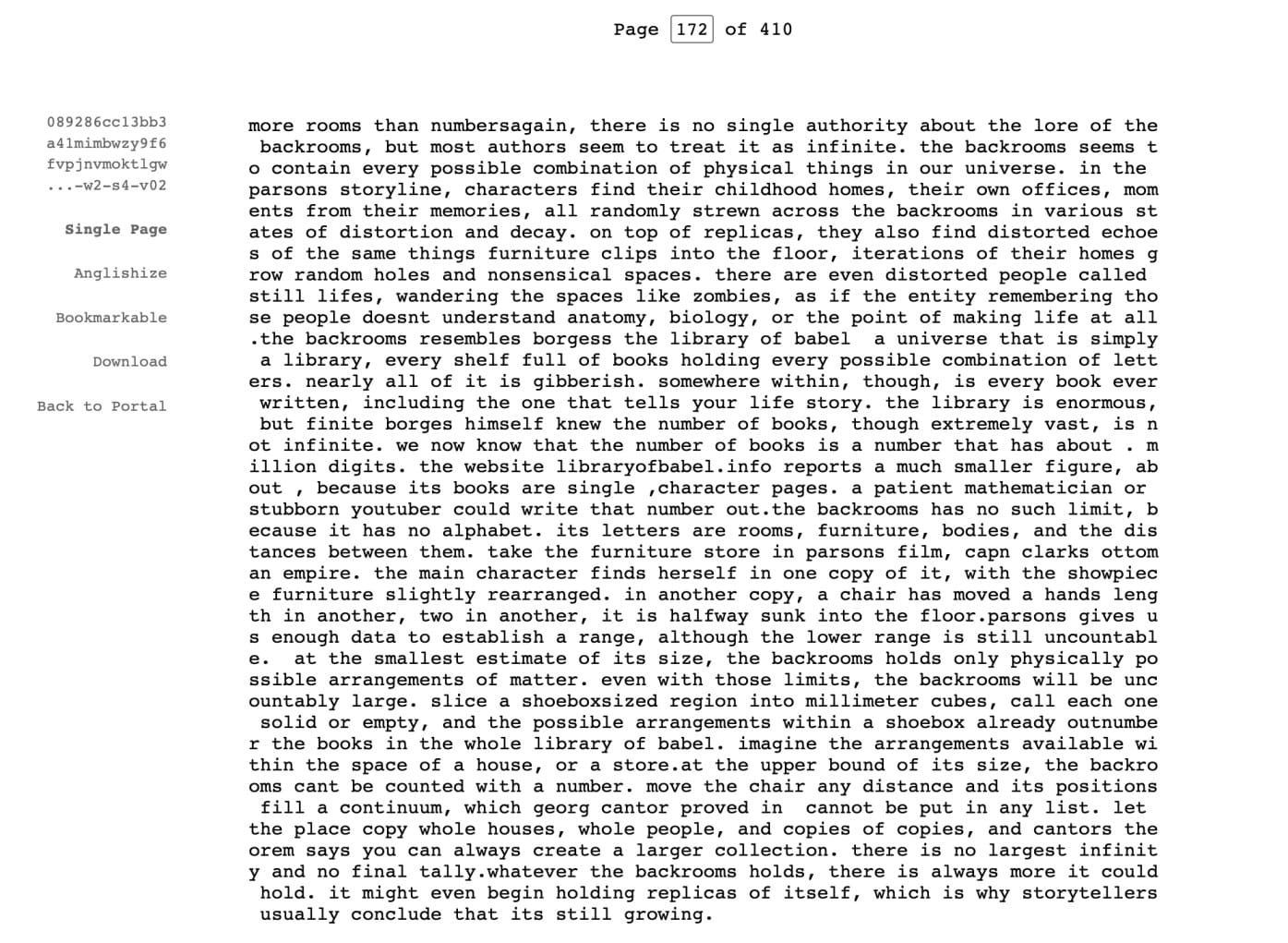
Sweet Potato hasn't completed his research yet, but he found this exact section as a passage in one of the books?! He even bookmarked it??? (https://libraryofbabel.info/bookmark.cgi?sweetpotatosfind67)
I’ve started thinking of The Backrooms as the latest eldritch god. It’s something you’d expect to find in H.P. Lovecraft, or the SCP stories. The Backrooms has all the characteristics of an eldritch god. It is:
Cosmic in scale
Beyond understanding (beyond even numbering)
Unfathomably powerful, but limited to a certain domain of power
Totally apathetic (maybe hostile) towards all forms of life, including humans
Note that these same characteristics would also qualify The Backrooms as a chaos god according to many pagan religions. A pagan chaos god has cosmic power, acts beyond understanding, has a domain of interest, and does not care how it affects life on Earth.
But what would The Backrooms’ domain be if it’s a god? I think I’ve already hinted at the answer: infinite memory.
The Backrooms is an eldritch god of infinite memory. It doesn’t care about us, but it does store us, and it repeats our memories unto infinity. It holds everything, but cares for nothing.
This is another reason I’m fascinated by The Backrooms: The Backrooms is the most honest picture our culture has produced of a god: infinite memory, endless possibilities, and an infinite power to grow. The myth also explores what this entity would do for us.
It turns out that such a god would be a horror.
It would be like the eternal recurrence that haunted Nietzsche. It would present us with a constant reminder of the meaninglessness of our existence. A god like this would not save us from existential dread, from the fear of a meaningless life and a forgotten death.
This kind of god would simply shove our faces into the problem, let us agonize over it, and commit our agony to memories that will repeat again and again, forever.
The Backrooms qualifies as a god of the eldritch kind: cosmic, powerful, beyond understanding, apathetic. But is it a god worth worshipping?
By the classical definition, a true God would have to be infinite, would have to know and keep everything, and would have to love what He knows.
The Backrooms attempts all three criteria and fails them all. That makes it a false god, and the ways it is false happen to cause existential problems for us. If we want a God worth worshipping, one who could actually be the answer to our existential dread, we need something else.
Counterfeit Traits of a False God
1. It Copies but Can’t Keep
Let’s be precise about the counterfeit traits. In three ways, The Backrooms promises what a god should provide but fails, and each failure leaves a real human need unfulfilled.
The first counterfeit trait of this false god: it copies, but doesn’t keep. Even its memories decay.
Since The Backrooms gives physical form to everything it remembers, it doesn’t really forget anything. Nothing in The Backrooms cleans up the spaces. There’s also nothing to destroy what’s already there.
So there’s no mechanism for The Backrooms to forget like we do. It doesn’t really lose anything it remembers, it just loses interest, moves on, and begins iterating on the same memories until they decay into unrecognizable forms.
Walk far enough and you’ll find your childhood bedroom, your old family car, the couch you had in college, all sorted. And they will remain in place forever for all The Backrooms cares. The place doesn’t really forget. What happens instead is, as The Backrooms iterates on a thing, it begins changing its condition and form.
As one of the main characters from the movie, Clark, says:
“The more it remembers something, the less it does.”
Later in the film, Dr. Mary Kline sees The Backrooms iterate on the living room of her childhood home. The first iteration looks nearly identical. By the sixth iteration (which Dr. Mary finds herself trapped in), the room has devolved into cracked, yellowed walls, and the door replaced with a hole.
What strikes us as decay is simply one permutation amongst an infinity that The Backrooms wants to exhaust. It seems wrong to us because we attach significance to the original version in our world. But The Backrooms only wants to catalogue possibilities. It keeps everything and treats none of it as the original.
We encounter the same dynamic—memory causing decay—in our lives all the time.
Every time we use a magnetic tape, the reader head wears it down and ruins the data. Whenever we use a disc, it rots a little more, until the data can’t be read. So Parsons’ series is presented as degraded found footage from VHS tapes and floppy discs because decaying in the act of remembering is the fear.
The format contributes to the horror.
Even our own power of memory is liable to cause decay. One popular theory in the neuroscience of memory is called reconsolidation.
Reconsolidation holds that whenever you recall a memory, it becomes unstable for a time and it has to be stored again. In the meantime, it spends time in the active part of your mind, the same part that is constantly receiving stimuli and writing memories. So by the time that memory is stored again, the original memory gets mixed together with whatever you’re currently thinking, feeling, and experiencing. (Nader, Schafe, LeDoux, Nature, 2000).
If the reconsolidation theory is accurate, then we arrive at the same unsettling realization: every act of recall loses something in the process.
Random new stimuli and associations accumulate onto the original memory, becoming part of the memory, until the original content is distorted and unrecoverable. The memories you replay the most are the memories getting constant overwrites, most liable to decay. They change as you change, which means they won’t remain perfect replays of what happened.
The Backrooms scales the “memory creates decay” dynamic up into a whole universe, and the existential problem still doesn’t resolve. It holds more than any creaturely mind could hold. Yet it makes no difference to our existential dread, because memory alone doesn’t preserve anything. If memory causes decay, then we’ll always eventually end up with static, the white noise at the end of an echo, the heat death at the end of time.
Saying Yes to Eternal Recurrence
This section discusses Nietzsche and infinity. Nietzsche was a philosopher but he composed some music in his college years, and I learned to play some of it. Here is his piano piece “Unendlich”, (German for “infinite”) played by me, recorded 11 years ago. Listen here while you read.
The Backrooms reminds me of a story Friedrich Nietzsche wrote in The Gay Science, concerning eternal recurrence (§341). Nietzsche imagined a demon who tells us that we will live this exact life, an infinite number of times, down to the smallest details. After aeons and heat death, when the universe has exhausted every possibility and energy source, it will start again, and again, and again.
Nietzsche understood that most people would despair at the thought of living this life, and every permutation of it, ad infinitum. But Nietzsche believed eternal recurrence was reality. He thought we are in an endless march towards nothing, forever, with no god to save us or give meaning.
So the truly great man, according to Nietzsche’s story, would be so resilient that he would look into that abyssal infinitude, find bliss in it, and tell the demon,
“I’ve never heard something so divine!”
Nietzsche knew most people would consider the demon’s revelation to be a horror. The point of Nietzsche’s story was that we should embrace the horror until it feels like a blessing.
The Backrooms is Nietzsche’s eternal recurrence with a twist and some backstory. It’s basically eternal recurrence with entropy factored in. The Backrooms remembers everything, and repeats it forever. Once it exhausts every possibility (and it can’t), it will start replicating itself, with all the combinations within it.
Since my mind spends way too much time at the heat death of our universe, this trait of The Backrooms hits my existential reflex. I feel the story touching on the same dread: “nothing in life nor death matters, and nothing will be remembered.”
Even if you have an eldritch god to remember and replay infinite versions of your life and death, that doesn’t really fix your existential problems. Endless iteration of a meaningless life still leaves it meaningless. The eldritch god of infinite memory would make it so that nothing, including your suffering, would ever really end, either.
You wouldn’t even get the mercy of a definitive death.
But Nietzsche’s answer to the demon (and to The Backrooms) is to say yes. He gave the attitude a name, amor fati, "the love of fate".
I admire Nietzsche. His solution is the best anyone could do in a Godless, unending world. But it still fails to ease existential despair, because it asks us to call insanity “bliss.”
Look at what the demon describes: the same suffering, forever, with no purpose and no exit. If a person described their own life that way, we would have them involuntarily committed and put on emergency Prozac, even if they claimed they were “embracing fate” or “living for the moment” or whatever.
Seeing an eternal cycle of suffering and decay and calling it “divine” instead of “horrific” doesn’t change anything objective in the situation. We’re just shifting more work onto our own mind and asking it to gaslight itself until horror becomes bliss. Nothing gets better, the person just lies to themself, or goes insane. It's no coincidence that stories involving forbidden knowledge and eldritch gods usually end with the protagonist going insane instead of fixing the problem that drove the story.
So amor fati isn’t a solution at all. It’s more like shooting up with morphine for the high.
2. It Grows but Never Arrives
The second counterfeit trait is The Backrooms’ most famous characteristic: it never ends. There will always be another possibility the space could hold, and thus The Backrooms must be constantly growing.
Philosophers have wrangled with infinities that can never be satisfied, like The Backrooms. Hegel would call it “the bad infinite” or “spurious infinite”: a series that never completes. You add one, then add another, and you can always add another.
As a bad infinity expands, it is “not a real advance but a repetition of the same: building up, tearing down, an impotence of the negative.” (Hegel, Science of Logic, Quantity, §503)
You could paraphrase Hegel here and it'd be the perfect inscription to hang above the gate of The Backrooms: “A room, then another room, then another, and the rooms will never end.”
And beside Hegel, you could also hang Aristotle’s words on potential infinities as a second inscription: “It is not what has nothing outside of it that is infinite, but what always has something outside it.” (Physics III.6.207a).
A thing that always has something outside it is never whole. It is endless because it can never be satisfied.
In other words, The Backrooms is a potential infinity, trying to become an actual infinity. But potential infinities are as far from actual infinity as we are. The Backrooms cannot ever be satisfied, which makes it a false god and leaves us in existential despair.
The thing about living creatures is that we need definitive ends. We need rests to create rhythm, and we need purpose to make life worth living at all. So if the best that a god of infinite memory can offer us is a bad infinite, an potential infinite, then they’re only making the problem of meaninglessness worse.
Again, we no longer even get the mercy of death. Neither will we ever arrive at a goal nor a milestone. We enter an infinity that, by definition, can never be satisfied, so how can we expect to find satisfaction ourselves?
3. It Stores but Doesn’t Love
Sometimes I think my worst fear is being forgotten. But The Backrooms proves me wrong. There is a fate worse than being forgotten: being remembered forever by something that does not care.
It’s possible to be remembered while still in Hell.
The Backrooms seems to have some alien form of consciousness. But it does not care for us or anything it remembers. Nothing is arranged for the sake of anyone. It’s a space that doesn’t exist to be inhabited, or even explored.
It seems The Backrooms only exists to manifest all possibilities, nothing more. Hallways, furniture, and spaces in there turn up in arrangements that make no human sense, because it does not care about human sensibilities, and has no reason to.
It is the ultimate archive, without an archivist to guide it, and no audience to care about what’s stored within.
Think through the problem with me: suppose there’s some new god, capable of remembering every detail of my life: every meal, every conversation, and every action. It can even make copies of me, infinite copies. It can give life to every possible version of me. And none of these copies will ever be destroyed.
Does that god solve the existential fear that everything I do seems meaningless? No, it does not console me from that fear, nor offer salvation from the uncaring universe. It just multiplies zero meaning an unfathomable amount of times, and the result will still be zero meaning.
Being remembered does not equate to being saved, or being loved.
A replica of my life, or even a full replay of my life, and an exploration of every possible life I could’ve lived, wouldn’t meaningfully change the existential problem. A record of my life and all possibilities that nobody loves, nobody witnesses, and gets distorted every time it’s touched, is no rescue if the universe is already meaningless.
All will still be headed towards heat death, except now, through The Backrooms, we have a veeeeeeery long detour to the same end, and then we’ll start over, ad nauseam.
Thus, The Backrooms is something worth reflecting on philosophically, because it’s nihilism with a story. It’s how our culture is currently confronting nihilism. Its horror—its forbidden knowledge—is simply existential dread, brought about through a bad infinity with some lore.
The Backrooms has us enter the mind of an eldritch god with infinite memory. While there, we realize that this kind of infinity and this kind of memory is actually Hell, expanding infinitely.
But here’s where I get worried: The Backrooms confronts the viewer with dread, absurdity, and despair, but doesn’t offer any solutions. The story makes us ruminate on real fears and real problems, but leaves without any real path forward.
The existential fear and nihilism can’t be solved by just making another eldritch god, maybe bigger or stronger. The reason The Backrooms fails to solve any of our problems is not a matter of power-scaling. The problem is that we need a wholly different kind of Being.
Not a god, but a God.
A True God Has No Edges
Put together all three counterfeit traits that make The Backrooms a false god. The Backrooms:
Copies, but can’t keep
Grows, but never arrives
Stores, but doesn’t love
Each of these counterfeit traits leaves a real human need unmet. We need what we love to be kept. We need the journey to arrive somewhere. And we need the one remembering us to love us.
Fixing only one would still leave us in a horrific universe. Moreover, it isn’t clear how any eldritch god, or pagan god, or any such entity could do much differently. Eldritch gods don’t care about humanity, and myths where they get involved usually make things worse for us.
Pagan gods, like the Greek pantheon, are at least more predictable, but not even Zeus could do anything for souls once they died.
We need an entity on a whole different plane of existence from where the eldritch and pagan gods would live. The classical doctrine of God, the God that the classical theist traditions attempt to worship, does offer something radically different. And this God can do so because He exists in a wholly unique way, the One who is “absolutely absolute,” as the philosopher John Deely wrote (Intentionality and Semiotics: A Story of Mutual Fecundation, 141; see also my dissertation, 219).
This God is an actual infinity, eternal memory, and love itself. And these qualities, as Christian tradition has discovered, must not even be separable qualities at all in this God. We will take them in that order, infinity first, because the other two depend on it.
An Infinity That Is Already Whole
Start with infinity. The God worshipped by the Church is an actual infinite. His being isn’t limited by anything because He is the fount of all being, complete in Himself. Anything that exists has its being on loan from God. There is nothing to limit this kind of infinity, because everything that exists depends on Him, and every possibility lies within His power and is present to His mind, though not every possibility is made actual.
This God’s Being doesn’t exist because a sequence of addition finally broke through to infinity; it simply is, so there’s nothing to add. The Backrooms has to keep moving the chair a hand’s length further to see what comes next. God has no next room to find.
Thus, the New Testament ends with this God announcing: “It is done! I am the Alpha and the Omega, the Beginning and the End” (Revelation 21:6). So even though this God is actually infinite, there’s still a story headed towards Him, and that ending is a Person (or Three) to be in a relationship with.
Granted, it’s an infinitely powerful person, and the relationship can never be truly exhausted, but that’s a good infinity, not a bad infinity. I'll explain the difference more when I'm responding to objections.
A Memory That Cannot Decay
Next, memory and eternity. The main problem with The Backrooms’ memory is that it’s essentially still just a creature’s memory. External objects radiate impressions, a viewer receives those impressions, those impressions are then memorized and the viewer later expresses those memories.
It’s a read/write dynamic, and information can get lost between the object and the viewer, within the viewer as they memorize the object, and between the viewer and the medium in which they express what they remember. Potentials for errors are always present in that form of memory.
Yet, Boethius defined eternity as “the simultaneously-whole and perfect possession of interminable life” (Consolation of Philosophy V.6, quoted in Summa Theologiae I, q. 10, a. 1). This will be important for understanding God’s memory, and how it’s different.
Nothing in God recedes, so nothing in Him has to be retrieved, and nothing wears down by being recalled. Thus, “memory” in God doesn’t work like the memory of any limited being. “Memory” for an eternal God means knowing everything as present.
In Christian tradition, God’s memory doesn’t start by receiving impressions from an external thing. God is an artisan who plans beforehand. That plan is His memory, and the world is in a constant state of creation as He makes that plan real. God’s memory isn’t passive, waiting on impressions to come in, but active, even creative. It works before anything exists, and gives being.
There is nothing for this God to copy in memory, because God’s knowledge is already the cause of it. And God is constantly willing it to exist. So with the “absolutely absolute” knowledge, memory, and will of the classical God, there are no gaps in the process for a memory to become corrupted.
Plato called time a “moving image of eternity” (Timaeus 37d). Both The Backrooms and eternal recurrence are trying to be “moving images of eternity” by endless looping within time. But repetition, their main mechanism, shipwrecks their hope from the beginning, because true eternity doesn’t repeat.
The true God doesn’t need to repeat anything in His memory, because He is present for all of it, all at once, and giving everything being. In God's memory, there is no need to iterate on Dr. Mary’s living room, and no reason to recreate it with every possible difference. The room as it was, and the childhood that happened in it, would be present all at once, held as themselves, and possibilities known, but not made real.
In the sense of repetition, God is totally still.
A Love That Creates Being
Last, love, which is intertwined with both God’s infinitude and knowledge. God’s memory gives everything its being. And since it is good to exist, giving being to things is an act of love, constantly given. (ST I, q. 20, a. 2)
Moreover, God has purposes in mind from the start. So even though every possibility is available to His creativity, He isn’t interested in creating random permutations for the sake of exhausting every possibility.
Where The Backrooms vomits out possibilities without any care for coherency, the classical God has purposes in what He creates: each thing has its own nature, capabilities, and relations to the things surrounding it.
The Backrooms creates copies of people without purpose, just to exhaust possibilities. The true God creates distinct people because He loves them, and they have a role to play in the story.
An eldritch or chaos god creates and abandons, without love. The classical God begins by loving, then creates, then maintains.
Now set the counterfeits beside the real thing. A God worth worshipping ought to:
Know all things perfectly, without corruption
Already be an actual infinite—no need to grow
Remember and love
And thankfully, we live in a reality where this God exists, and the eldritch gods do not. In fact, Christian tradition argues that nothing could possibly exist unless an eternal and unlimited God already exists (the First Way: ST I, q. 2, a. 3, “nothing can be reduced from potentiality to actuality, except by something in a state of actuality”).
And these qualities are not even really separate in the classical God. If they were separable, they’d be liable to decay. Somehow, everything about God is just one characteristic. We can talk about them separately, but in reality they are all somehow simply the same thing.
Hence, Aquinas teaches that God has no parts, and that He is identical with His own nature and existence (ST I, q. 3, aa. 3–4, 7). His knowing, willing, loving, and being are a single act. The apostle John says it in three words: “God is love” (1 John 4:8).
In The Backrooms, power, memory, and all its other characteristics can come apart. There’s nothing necessarily connecting everything together. As a contingent being, there’s no reason The Backrooms must necessarily exist, either.
But the classical God exists in a wholly different way; He is not built out of anything; He simply is, necessarily, and everything flows from that fact.
Objections, Concerns, & Worries
Sisyphus, Blessed?
A reader who knows the Great Works will have an objection. Gregory of Nyssa taught that the soul’s life in God is an endless climb, always reaching forward, because God can never be exhausted (Life of Moses II.239).
So doesn’t the classical God leave us with the same problem: an endless toil?
No, because despite being endless and eternal, there’s still purpose in it: building a relationship with a Person. It isn’t endless because it lacks purpose; it’s endless because the purpose is so potent that it can never be exhausted.
In The Backrooms, you can continue exploring forever because there’s no reason for anything to exist, and no reason for you to keep looking. You become Sisyphus pushing the stone up the endless mountain. Camus, in the spirit of Nietzsche, asks us to imagine Sisyphus happy, simply because he’s come to terms with an eternity of worthless toil.
But the classical God allows us to go even further and imagine Sisyphus blessed, because the nature of the journey changes. Imagine God holding the mountain and stone in existence, powering Sisyphus’ work, helping him push the stone, and building a relationship alongside him, all at once.
It’s still work, but it’s the work of bonding instead of drudgery. You are building something good alongside an infinite Person (or Three). It will be remembered, and it will last forever, and the goodness within will never be exhausted, but continually perfected.
Saving the Past vs Recording the Past
Another fear needs to be addressed, concerning the worst parts of the past.
The classical God is ever-present at every moment, including the worst ones in our past. Isn’t that a horror?
Granted, Christian tradition has always held that God can’t erase any moment in the past, since that would be a contradiction (ST I, q. 25, a. 4). Our worst moments do stay in God’s memory.
Yet, the tradition has also always held that somehow, nevertheless, the true God will still redeem those moments. How is still up for debate, and will be debated until God finally does it. But we have some hints through the Resurrection of Christ; He was murdered, yet when He returned, He kept the wounds. The victory He achieved was so joyous that the wounds from His murder became means of grace.
There is a lasting paradox in Christian tradition on suffering and redemption, but that’s a welcome relief from the flat verdict of nihilism: “This, and everything like it, is worthless.”
The classical God has some way to redeem the past, even the worst of the past.
The Backrooms revisits the past to copy it. The classical God revisits the past to heal it.
The Backrooms myth expresses our collective existential fears. Reflect on the myth, and you end up reflecting on eternity, the nature of infinity, the nature of gods, and our deepest needs.
The myth by itself only leaves us with negations: we are lacking, even a god would fail us. Parsons’ Backrooms myth has us exploring endless hallways, and lets the existential dread stay with us.
Feeling this dread is not a lack of faith. You’d think the words “Meaningless! Meaningless! Utterly meaningless! Everything under the sun is meaningless!” were spoken by someone trapped in The Backrooms.
They aren’t. Those are the opening lines of Ecclesiastes. The same book of scripture supplies this essay’s title: “there is nothing new under the sun” (Ecclesiastes 1:9). The endless yellow rooms are the best illustrations of Ecclesiastes’ despair that we’ve seen in a long time.
Yet, even the author of Ecclesiastes, in spite of his despair, commands us in his last chapter, “Remember your Creator in the days of your youth” (12:1), and says earlier that “God will call the past to account” (3:15). In The Backrooms, the more it remembers something, the less it does. Yet the Church worships a God who cannot lose memories, who exists beyond the sands of time.
Put that way, the classical God is kinda eldritch. God’s love, knowledge, and infinitude are all beyond our understanding. That is eldritch, and scary. Cosmic scale, mystery, and power all belong to Him too.
The one mark He lacks is indifference: this God is absolutely not apathetic or hostile towards us, and that makes all the difference existentially when you compare this God with eldritch gods. With this God, there’s still a great realization, but instead of finding forbidden knowledge that drives you insane with despair, there’s a revelation that answers all fears.
Memory Eternal, and God Save Cinnamoroll
The Church worships a God who simply is, without beginning or end. The One who remembers, and somehow redeems all memories. The One who offers an endless unity, an endless journey that is also an endless blessed rest.
Thus, in our funeral services, the Church chants “Blessed repose and eternal memory.” And we see it as a blessing.
I said at the start that whatever entity saves us has to save all the beautiful things too, like @hanamintsukimin’s drawings of Cinnamoroll. The Backrooms would keep Cinnamoroll and let every copy go a little softer than the last, until nobody could say what the first one looked like.
The Church claims something stranger. Jesus says of sparrows, sold five for two copper coins, that “not one of them is forgotten before God” (Luke 12:6).
If the cheapest birds in the market are not forgotten, then neither is anything good and beautiful, even when the world forgets it. Cinnamoroll is not lost, nor the hands that draw him with care, nor a single soul. There is a floor to land on after you suddenly fall into the fear.
I know that, but that old feeling may never go away, even when I see lovely Cinnamoroll art. I’ll probably feel that “this, and everything like it, is worthless, and it too will disappear.” The answer I know may stay silent in my mind, but that doesn’t make it false.
This too, like all things, is known by a Memory that does not blur, does not decay, and does not look upon us with indifference.
☦️❤️🐍
Being stored isn’t the same as being known. A manuscript in a folder, or a mission statement on a website no one visits, is still waiting for someone who will actually read it with care. Don’t let your work fall into The Backrooms. If your words are sitting in a room somewhere, we’ll help you rescue them. ⬇️
Works Cited
Art & Media
Hanamintsukimin (Mattake, まったけ). Cinnamoroll drawings. Instagram. https://www.instagram.com/hanamintsukimin.
Kane Pixels (Kane Parsons). The Backrooms (Found Footage) and related videos. YouTube, 2022–. https://www.youtube.com/c/KANEpixels.
Parsons, Kane, dir. Backrooms. A24, 2026.
Scholarly Works
Aquinas, Thomas. Summa Theologiae. Translated by the Fathers of the English Dominican Province. 2nd and rev. ed., 1920. New Advent. https://www.newadvent.org/summa/.
Aristotle. Physics. Translated by R. P. Hardie and R. K. Gaye. In The Complete Works of Aristotle: The Revised Oxford Translation, edited by Jonathan Barnes, vol. 1. Princeton, NJ: Princeton University Press, 1984.
Boethius. The Consolation of Philosophy. Book V, prose 6. Quoted in Aquinas, Summa Theologiae I, q. 10, a. 1.
Borges, Jorge Luis. “The Library of Babel.” 1941. Translated by James E. Irby. In Labyrinths: Selected Stories and Other Writings, edited by Donald A. Yates and James E. Irby, 51–58. New York: New Directions, 1962.
Camus, Albert. The Myth of Sisyphus and Other Essays. Translated by Justin O’Brien. New York: Vintage International, 1991. First published 1942.
Cantor, Georg. “Über eine elementare Frage der Mannigfaltigkeitslehre.” Jahresbericht der Deutschen Mathematiker-Vereinigung 1 (1890–91): 75–78.
Deely, John. Intentionality and Semiotics: A Story of Mutual Fecundation. Scranton, PA: University of Scranton Press, 2006.
Goss, Boaz. “Free Will and Neuroscience: A Thomistic Corrective to Neurodeterminism.” PhD diss., Saint Louis University, 2023. ProQuest, 30311068. https://www.proquest.com/docview/2801922568.
Gregory of Nyssa. The Life of Moses. Translated by Abraham J. Malherbe and Everett Ferguson. New York: Paulist Press, 1978.
Hegel, G. W. F. Science of Logic. Translated by A. V. Miller. London: George Allen & Unwin, 1969.
Nader, Karim, Glenn E. Schafe, and Joseph E. LeDoux. “Fear Memories Require Protein Synthesis in the Amygdala for Reconsolidation after Retrieval.” Nature 406 (2000): 722–26.
Nietzsche, Friedrich. The Gay Science. Translated by Walter Kaufmann. New York: Vintage Books, 1974.
Plato. Timaeus. Translated by Donald J. Zeyl. In Plato: Complete Works, edited by John M. Cooper. Indianapolis: Hackett, 1997.
The Holy Bible. New International Version and New King James Version. Quoted via Catena. https://catenabible.com.
Comments are welcome. I read everything, but my charism is writing, not debate. So I respond selectively, only when conversation clearly serves truth and charity. If you don't receive a response, please don't take it personally. Time and energy are precious resources, and I steward them toward the essays themselves.
All comments go through moderation.
If you'd like to engage more substantively, consider writing your own response essay and contacting us through email or social media. I'd be honored to read it and potentially feature it as a guest essay.
☦️❤️🐍
~ Dr. Boaz
The Serpentine Byzantines

Joint Dr. Boaz, the Human
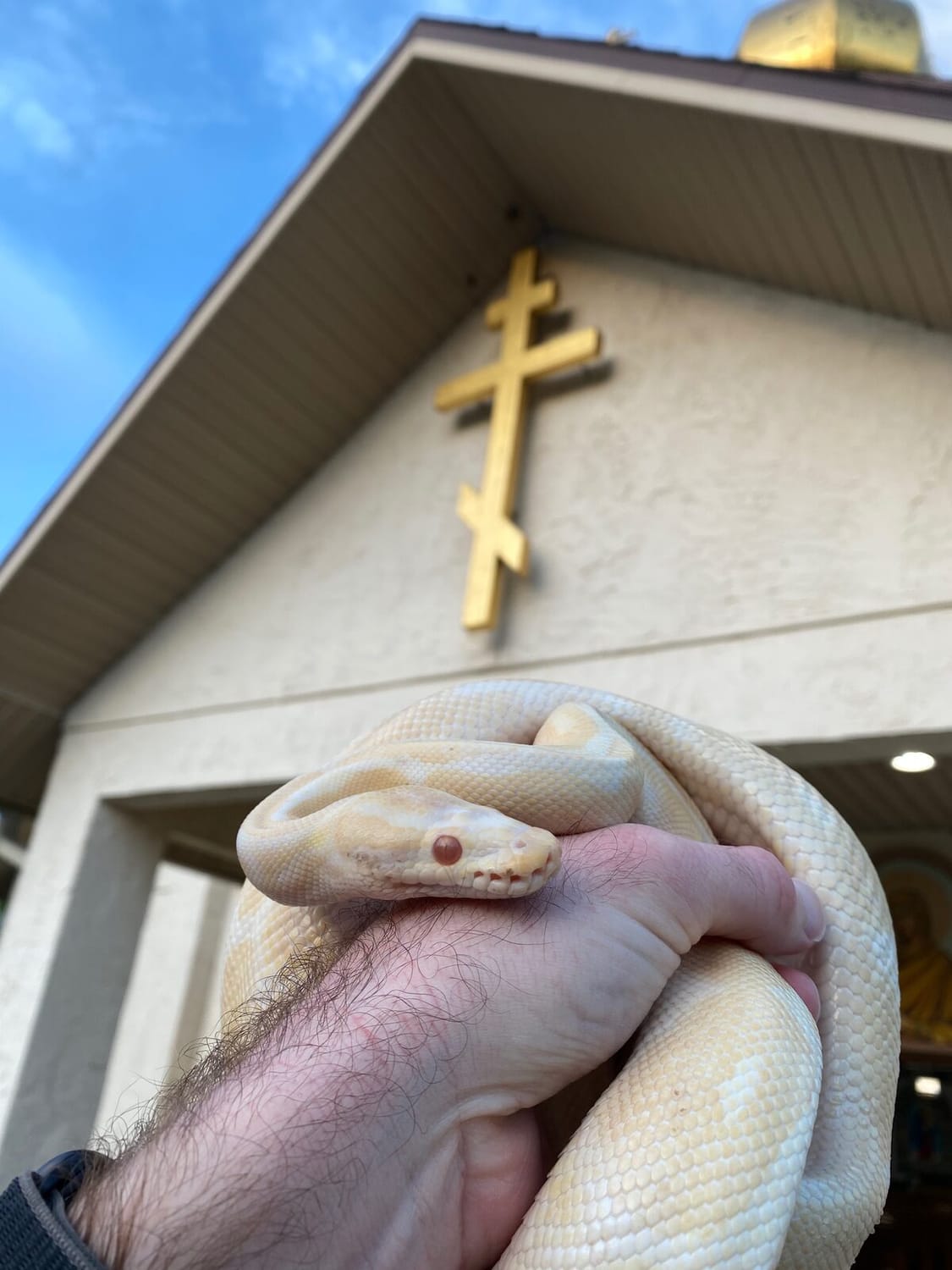
Sweet Potato, the Ball Python
We're a small team comprising a human and a snake.
Joint Dr. Boaz has a Joint PhD in Healthcare Ethics and Theology. He lives a 2nd life as a professional dancer. He's also a parish cantor, visual artist, and gaming streamer.
Sweet Potato is a male albino Ball Python. Born and raised in Florida, he's also traveled across the USA via road trips and even a flight! He's been blessed by a priest and once completed an entire Paschal Fast without eating a single meal.
Let's Connect!
All content © 2020-2026 The Orthodox Snake Writing Agency LLC